Organizing Kids' Clubs, Teams, and Activities Without Losing Your Mind
Every September and every January, the same wave hits our house. Sign-up emails for soccer, permission slips for scouts, a rehearsal schedule for the school play, and a piano teacher who needs to know our availability by Friday. When you have more than one child, those little commitments multiply fast, and suddenly Tuesday looks like an air traffic control screen.
After a few seasons of double-booking myself, missing a uniform wash, and driving to the wrong field, I built a system that actually holds up. It is not fancy, and it does not require a color-coded spreadsheet with forty tabs. It just requires one calendar, one short weekly ritual, and a few ground rules the whole family understands. Here is exactly what works in our house, refined over years of practices, games, recitals, and club meetings.
Start With One Master Calendar
The single biggest fix was giving up on separate calendars. My husband had his schedule in his phone, I had a paper planner, and the kids' activities lived in my email inbox, which is another way of saying they lived nowhere. Now everything goes onto one shared family calendar that we can all see. When a coach announces practice times, they go in that day, along with the address of the field, because I have learned the hard way that 'the usual place' is never as usual as everyone thinks.
Each child gets a color, and recurring activities get entered for the whole season at once, not week by week. I also block out the immovable things first: school hours, work schedules, church, and family commitments. Activities fill the space that is left, which makes it painfully obvious when we are trying to squeeze in one thing too many. If it is not on the calendar, it does not exist, and that rule has saved us more arguments than I can count.
The Sunday Night Planning Ritual
Once a week, usually Sunday after dinner, we spend fifteen minutes looking at the week ahead together. It sounds formal, but it is really just coffee, the calendar, and a quick sanity check. We catch the conflicts while they are still small and fixable.
- Review every day out loud. Reading the week aloud surfaces the overlaps your eyes skip over, like two kids needing rides in opposite directions at 5:30.
- Assign the driving. Decide who takes whom, and who is on pickup duty, before Monday morning turns it into a negotiation.
- Check the gear. Uniforms, instruments, water bottles, and permission slips get located and staged by the door.
- Flag the pinch points. Every week has one rough day. Naming it early lets you plan an easy dinner and lower everyone's expectations a little.
- Confirm the odd events. Anything unusual, like an away game or a tournament, gets a quick double-check against the original email or schedule.
Build a Command Center That Actually Works
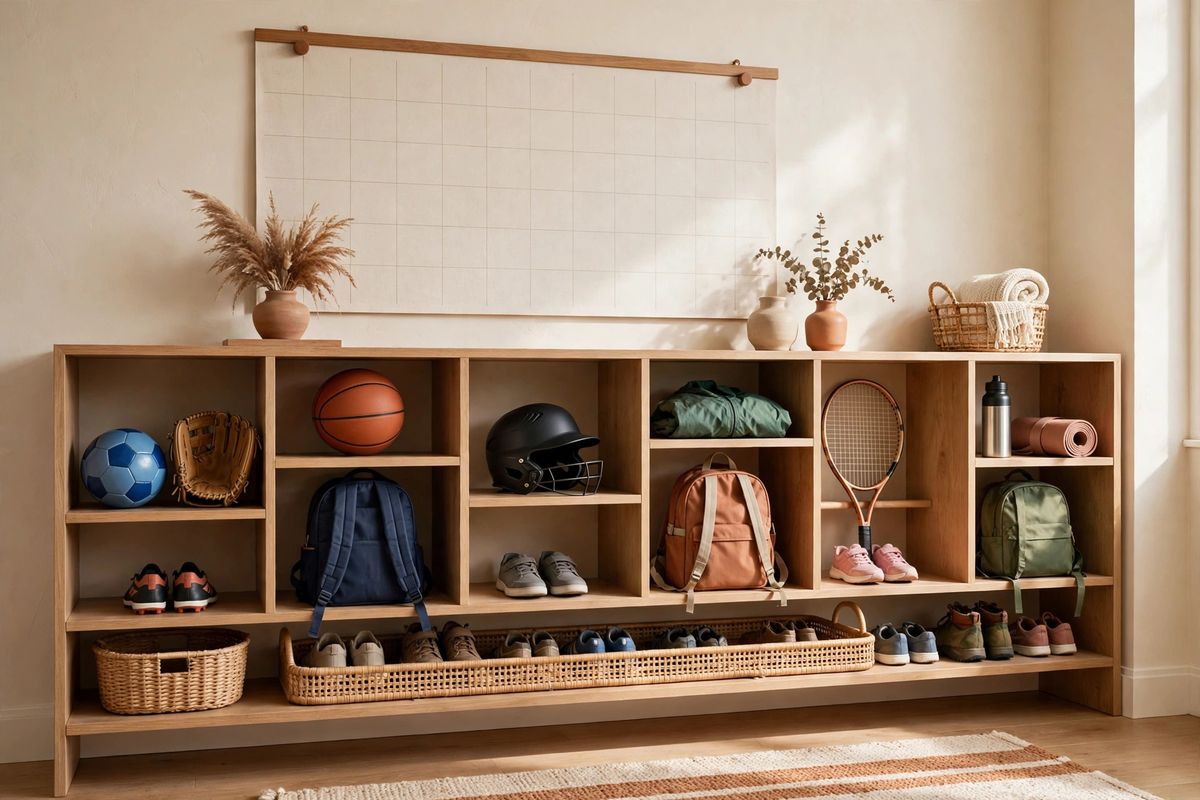
Paperwork is where activity chaos breeds. Forms, schedules, and fundraising sheets used to colonize my kitchen counters. Now we have one small command center by the back door, and every piece of activity paper has a home there.
- A wall calendar showing the current month, so anyone can answer 'what is happening Saturday?' without finding a phone.
- One folder or bin per child for forms, schedules, and anything that needs a signature.
- A hook or cubby per activity bag, so the soccer bag, dance bag, and scout backpack are packed and waiting instead of being assembled in a panic.
- A small whiteboard for this week's notes: early dismissals, snack duty, carpool changes.
- A pen that lives there permanently. This matters more than it should, but a missing pen is how forms end up unsigned.
The rule is simple: activity stuff enters the house and goes straight to the command center. It takes a week or two to become habit, and then the counter stays clear and the morning scramble shrinks dramatically.
Set Limits Before the Season Starts
The hardest part of organizing activities is not the calendar. It is the sign-ups themselves. Kids are enthusiastic in September and exhausted by November, and parents are usually the ones who pay for that gap in the form of frantic evenings and short tempers. Our house rule is one sport and one club or lesson per child per season, and we revisit it together before registration opens. Some families can handle more, some less, but the number matters less than deciding it on purpose instead of drifting into overload.
We also protect at least two weeknights with nothing scheduled. Those evenings are when homework gets done without tears, dinners happen at a table, and everyone, including Mom, gets to breathe. When a new opportunity pops up mid-season, it has to fit into the existing structure or wait until next season. Saying 'not this time' to a good activity is hard, but saying yes to everything is how a family calendar becomes a part-time job.
Your calendar should serve your family, not the other way around. If every week feels like a logistics emergency, the answer is almost never a better app. It is usually one less commitment.
Survival Kits for Busy Afternoons
Even with a perfect system, there will be back-to-back evenings where you go straight from school to practice to a game in the next town. A stocked car kit turns those nights from miserable to manageable. Ours lives in a bin in the trunk and gets restocked during the Sunday ritual.
- Non-perishable snacks that can stand in for dinner in a pinch: granola bars, crackers, fruit pouches, and trail mix
- A case of water bottles, plus one refillable bottle per kid
- A spare change of clothes for the youngest child, because spills and muddy fields are guaranteed
- Wipes, tissues, a small first-aid kit, and a phone charger
- Books, coloring pages, or a deck of cards for siblings stuck in the stands
- A blanket for cold bleachers and an umbrella that actually stays in the car
Frequently Asked Questions
How many activities are too many for one child?
Watch the child, not the neighbors. If homework, sleep, and free play are getting squeezed most weeks, or your child starts dreading something they used to love, that is the real signal. Many families find one sport plus one club or lesson per season is a sustainable rhythm, but your family's capacity is the right yardstick.
What is the best way to handle carpooling?
Ask early and be specific. At the first practice, find two or three families who live near your route and propose a simple rotation with names and days written down. Put the carpool plan on the master calendar so nobody has to reconstruct it from a text thread at 4:45 in the afternoon.
How do I keep track of multiple kids' schedules without going crazy?
One shared calendar with a color per child, entered for the whole season at sign-up time, plus a fifteen-minute Sunday review. That combination handles about ninety percent of the chaos. The rest is gear staged by the door and a car kit for the nights when the plan meets real life.